Tuesday, August 30, 2011

American Realism in XX century Part One

Since art historians are people of ideas, delighting in finding conceptual, seemingly beautiful abstract constructs they irresistibly are attracted to the kind of art that begs for exegesis.
 The temptation is just too strong and who would blame them for yielding into the impressive acrobatics of flexible ideas. Modern art is perfect in this one instant- it screams for explanation. And art historians, with vigor worthy of a better cause jumped at the chance to knit and weave the most astonishing web of absurd theories, explanations, and commentaries encasing each puny piece of modern art in protective cocoon against common sense reactions. Outcome of this tendency is powerfully reflected in books on XX century art and in museums across the country. Modern art is therefore presented as the shimmering efflorescence, the precious bloom of artistic effort of that century, all due to the tendentious, cross-eyed hatred of both beauty and reality.
Yet, another art history should be written of that period, where dilettantish smears and splatters would be wholly omitted, while artists of true and lasting merit would take their rightful recognition. It will take a good while, not because the obvious fraud is not obvious, but because the powers behind the sham of modern art are very, very strong.
In the first decades of the XX century American painting faced a dramatic fork in the road of artistic choices. Painters could have joined realism or follow the newly exported European modern art. American realism had roughly two thematic realms of inspiration; urban and “regional”, meaning rural.
All of the painters of American realism, while rejecting cubism and abstraction had taken some elements of European modern art. Some have intensified their color and light along the French examples of impressionism, others “loosened” their brushstrokes which no longer were hidden, but flaunted them as some misguided virtuosity of post-impressionism, also from France. With those influences they turn toward American scene and brought us large harvest of fresh, not painted before images of local life.
Painters whose artistic origins were rooted in XIX century realism were creating splendid works often for another quarter of a century. John Singer Sargent painted a magnificent mural commemorating solders of the First World War.
                                                          John Singer Sargent "Gas"

William Paxton is another painter whose realism has roots in XIX century and painted well into mid-twentieth century. There is very alluring serenity in his interiors filled with coloristic delight no less admirable than in paintings of great Jan Vermeer.
                                                               William McGregor Paxton 

One of the most influential painters of the first quarter of the century was Robert Henri. His pronouncements concerning painting sound appealing, because he calls for learning to “see” and for expressing “life”. 
                                                                Robert Henri "Cumulus"

At a sober distance one has to ask if hasty, excessively sketchy lathering of sloshy paint is really effective way of bringing “life” into a painting. It certainly gives permanent sense of something provisional, done in inexplicably great haste, rushing to sign it before paint has been turned into the flesh of objects it is depicting. Being a charismatic figure he instilled in a long row of very talented painters the method of agitated, provisional, smeary manic brushing, as if they were whipping ,flogging their canvases with thick goo. If his credo was “seeing” than surely no one can see outside of their canvases all those deposits of raw paint. In humility, appropriate to the devotional task of painting the world, all silly gimmicks should be put aside and painting has to be understood to be an image appearing behind a surface of a mirror.
Here are some choice examples of the works of his circle.
                                                      George Luks "Paddy Flanagan"

                                                        John Sloan Drying Hair"


                                                          George Bellows "The Circus"

                                                                        Everett Shinn
.                                                                     Reginal Marsh


Instead of leaving some provincial surroundings and moving to New York to paint city life or join modernism and propel the wheels of recognition, one could defiantly stay put and  make art of that world.
It became known as “regionalism” and they painted Mid-West..Two convictions these Midwesterners had in common: they chose to paint land and life of their own origins and they rejected modernism, not because they were traditionalists but because they viewed modern art as empty formalism.
 The best, by far representative of the regionalism was Grant Wood of Iowa.
His portraits are much more successful than landscapes. There is far too much toy-like look of buildings and trees, the fields have neatness only hairdresser can achieve, like backgrounds of animated movies. Excessive stylization was somehow in the air of the epoch and art of regionalists would have been much better had it resisted the temptation.


                                                                    Grant Wood

John Steuart Curry was a regionalist from Kansas.
                                                              John Steuart Curry

Thomas Hart Benton from Missouri was very prolific artist with an instantly recognizable style. The Mexican muralists and Benton shared the taste for highly stylized forms but artistically he was never as good as Diego Rivera. His compositions are usually chaotically atectonic ,his figures lack the degree of observation and study of actual human figure to make them compelling rather than contorted .Still, with those shortcomings his huge body of work shows great inventiveness of subject matter and admirable ability of poeticizing ordinary life.

                                                             Thomas Hart Benton

End of Part One.

Tuesday, August 16, 2011

Modern Art is not our culture


This is portrait of Cecila Gallerani, known as “Lady with Ermine” by Leonardo da Vinci.


Is anything else needed than what is in view for the full enjoyment of this painting? Certainly not: everything that the viewer would need to fully inhale the beauty, the sublime refinement is provided by the painter who organized the content in such way that it would force each viewer in each viewing to respond with aesthetic delight.[ Neither Botticelli nor Ghirlandaio could succeed in their portraits to bring  this much presence of the sitter.]  Our innate sense of beauty and the offering of the painting were matched by the painter at such heights of experience we are left with awe.
Indelible experience of gazing at   “Lady with Ermine” [at the Czartoryski Museum in Kraków,Poland] requires no guiding help from an eloquent art critic or erudite art historian. All that is required is naked, direct contemplation.
Leonardo delivered the portrait to Lodovico Sforza in 1490.Let us move now five centuries ahead and see what was praised in Western Art then. Surprisingly, even shockingly when one consider the past five hundred years as time of hard work by very talented artists we arrive at the state of the arts where products presented in the halo of greatness look like this:

Franz Kline

Oh,no! This just must be some grim joke, a monstrous prank to scare us. Sorry, Leonardo- we have let the troglodyte barbarians take over our culture and replace it with their values.
To install excremental work like Kline’s in the temple of the arts could not happen on its own merits because there are none there. It was only possible by orchestrated network of opinion-makers, claque-manufacturers, foam-beaters of acclaim.
The natural, innocent reaction to a work by Kline, Hoffmann, Rauschenberg or Rothko is an instant recognition of total absence of art there, complete lack of aesthetic merit. To promote something so hideous as great art called for New-York size of “chutzpa”, and it worked beyond boldest con-dreams. All those smeary refuse is shown under the protective canopy of modern art “theory” which turns, miraculously, refuse into great art. That is why a cleaning crew, uninitiated into the modern art theory were putting “art-objects” into trash-bins thinking innocently that it was trash.
In essence modern art theory demands that painting has to reject depicting the world and become radically sovereign by concerning itself with forms and colors that do not resemble anything of the world outside of painting. Anything hinting at connection to the real world should be viewed as “anecdotal” and foreign to modern art. This way modern art ushered in formless blobs, chaotic smears, drips and dots, thick deposits of paint when showing how passionate they can be and stripes, squares, circles and angularities when hard edges of their disciplined, analytical approach was to be flaunted. Never thru ought the long history of Occidental art painting sunk so low. What is proudly exhibited in national collections, written about, lauded, awarded, taught at art schools, staring at us as public art, honored as the face of “our” culture is not ours at all. 

Monday, August 1, 2011

Public Art

Public art is commissioned by bureaucrats and paid by public funds. The purpose of its existence is to express some edifying general idea or belief which the public is expected to recognize as their own.
Of course no one is actually asking the public what it would want to be honored, commemorated or expressed in public places. Such decisions are left to Zeus-like administrators and sweet little committees of mostly women imposing their good sense of what would be “appropriate”.
The pool of these edifying ideas is actually very small because there is always some group of loud people ready to be offended by variety of ideas and to avoid in advance controversies there is ever smaller repository of public sentiments that can safely be expressed by permanent public art. As a result artists can exercise unfettered freedom of expressing political correctness and be handsomely rewarded for the good sense of pleasing the mind-controllers.
 Political correctness came to us straight from USSR, the system that covered tightly its land mass with alleys of Lenin statues from the Western Ukraine to the Kuril Islands, touching the toes of outstretched Japan. So much public love,” Amor sacro” provided many decades of busy work for artists of the Soviet Union.


Here in America political correctness has been attenuated, adopted to suit  country proud of its mythos of freedom. What worked best is what is simplest: avoid any controversial subjects. Thus public art embraced abstraction and what a happy union it proved to be. The fit is so clever and safe as if someone invented “nameless soup” so devoid of any identifiable distinct taste that no complainer could ever reject it by pointing to a floating bit and say “I hate leeks”. There is nothing there but boiled water and cosmic dandruff- so, eat it!


The title, rather surprisingly is “Olympia” as if this effort was tied to ancient Greek sculpture. Other possible titles are: “Swastika’s Vacation” and “Air Duct and I are Separated”. The quote from The New York Times explains:”... Formal and abstract metal sculpture dominates. “Olympia” (2008), by Maria A. Hall, is a large, dynamic abstract stainless steel sculpture installed in an open grassy area. Like all abstract sculpture, it is concerned with relationships of form, line and space.” If I were the the author of it I would be concerned too. Just look at this language: miraculously the stupefying primitivism is called “dynamic form” and mechanical, machine –made form is presented as concern for line and space?!!! No wonder they feel validated and legitimized presenting these pieces of obscene junk as art. Olympic Gods, please forgive her if you can.
Across the country there is tenfold as many or more of these idiotic pieces mascarading as sculpture as statues of Lenin were in USSR. The statues of Lenin were not high art: they were political kitsch and a very purposeful reminder who is in charge, like watch towers in their Mind-Gulag. 
What is seriously wrong with “modern sculptures” in public places  is that the source, the origin of their birth is not human heart or inspired mind .
2.

Just as it is in contemporary painting , parallel to Metallic Junk there are some worthy exceptions of serious figurative sculptures in public places firmly tied to occidental tradition.One such splendid piece of great art is a statuary of several figures installed in front of Banco Central in San Juan,Costa Rica.The author is Fernando Calvo.


Right in the heart of administrative, financial and political power stand a group of peasants to remind those in power of the people they govern. It is not an assembly of angry protesters and there is no sense of demand expressed there. These figures portray ordinary, hard-working, honest people who are not coming to complain about their lot, but their presence is very potent. Standing in front of the statuary it is inescapable to understand the clarity of their message. It is a bond of trust by which the hard toil of national labor will be done providing that the ruling class will protect laborers from exploitation, excessive greed and usury, corruption and vile manipulations. It is as if they installed this silent but eloquent, permanent reminder that they are “present”, which is the title of the sculpture.
It seems that this sculpture better than most shows how important public art can be, conveying meaningfulness, reaching into our social ideals to embody them with clarity, dignity and gravity.


Sunday, July 24, 2011

"Guernica" or Suffering of a Horse Indoors

One of the biggest icons of modern art is Picasso’s “Guernica”. It was commissioned by the Republican{Communist] government of Spain to commemorate the 1600 people killed by German and Italian bombers  that struck Basque village .Two powerful forces working together made the mural famous: western communism and proponents of modern art. Because the bloody dictators like Hitler, Franco and Stalin hated modern art it provided the chaotic, barbaric and infantile rubbish with nimbus of persecuted victims of tyranny. Fascists’ condemnation of modern art awarded it the elevated place in the gilded chariot of the liberal virtues, right next to personal freedom, freedom of expression and tolerance. From the late 30’s modern art has been placed under the protected wings of American Eagle and the flank of the British Lion.
In the secular hagiography of the West “Guernica” very quickly was sanctified and chosen by our cultural trainers as one of the “Treasures of the World”[PBS] on par with Gioconda or Egyptian Pyramids. But, just like in studying  surveillance photos of the worshipping crowd sharp eye will spot one or two reluctant participants, I should be counted as “Guernica-doubter”.
Because the outrage of the people over the massacre of civilians needed a symbolic object, “Guernica” was chosen to travel around the world as large banner of resistance against fascism. Serious scrutiny of its actual artistic success or failure has been made near impossible or irrelevant the very way that the image of Madonna of Guadalupe is not assessed as art. In just a few years after the horrific massacre of Guernica the American and British air raids far surpassed the fascists in the advancement of technology of killing civilians. Bombing of Pforzheim killed 18, 000, bombing of Dresden killed 25,000 and in Hamburg bombing  killed 42,600 civilians. If compassion were ever numerically proportional than the massacre in the Basque Viscaya would be overshadowed by the atrocities of World War Two. These unfathomable losses were made smaller in turn by Stalin and Mao, the greatest Father of Death the history ever had.
If “Guernica” is to be viewed as the symbolic icon of tragedy of war than it is right to examine the symbolic content of it. For reasons that are not understandable Picasso chose to make wounded or dying horse the center-piece of this huge composition.


 Perhaps I am not enough of a horse lover to be greatly moved by its obvious suffering, but it should be generally agreed the choice of that hippic trauma should not be made central in a painting commemorating 16 hundred people massacred by explosive and incendiary bombs. Glancing around the mural we see many more elements no doubt carrying some symbolic significance but very puzzling to those who would be looking for understandable images of air-raid victims. There is an image of a bull’s head as if advertizing strong brand of Rojo wine. There is a light bulb unaccountably lit up with powerful presence that does not seem relevant to the huge catastrophic horror of the event


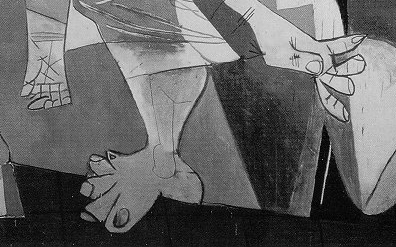
 On both extremities, left and right there are two figures of women with upturned cartoonish signs of suffering on their faces .Before they could escape, the author caught them with his cubist set of geometric torture tools and turned them into wretched cartoons .Look, because they are so prominent, at the hands and feet of those figures. Straight from a cartoon, distorted to be funny-looking as if made of finger-potatoes- inappropriate in the theme that should call for expressiveness of suffering Katte Kolwitz could show him.


Now let’s step back and take the whole poster-like image in and examine the emotions it generates. What are they? Pity for the dead, sorrow for the innocent, fury at German cruelty? Not really…more like confusion, sense of dynamic chaos caused by having a dying and kicking horse inside. No wonder the women are screaming. The gathered elements are so drastically incoherent that the only thread that holds them firmly together is the forceful display of the Picasso Style. That vantage provides the proper key to the famed mural. Forget killed villagers; think Picasso Brand showcased here to serve his egotism, to serve promoters of modern art as defenders of freedom from tyranny and to the public never questioning pronouncements of cultural instructors.

Sunday, July 10, 2011

Figurative taxonomy

   I have looked into the art of the Weimar Republic and read about the accepted division within the Neue Sachtlichkeit between art called “verism” and “magic realism”. If one would add “surrealism” to it and “realism” it would make nearly all branches of the taxonomy of figurative art of XX century.{I know of “pop-art” and “photo-realism” but ignore it because “pop-art” was cynical art market manipulation, not art and “photo-realism” is moronic copying of snap-shots, not art either]
Verism has its origin in distant past when Roman portrait sculpture departed from idealized realism of Greek sculpture and insisted on great degree of individualization. Another words-it was art of the truth. In the 20’s in Germany the truth-telling was not directed at form but at content. Artists of that trend painted grotesque scenes of social decay with gleeful sarcasm. What unites them is involvement, engagement with social, political aspects of contemporary world. Some used ambiguity of jeering and delight in depicting the excess, debauchery, turmoil. Dix and Schlichter are outstanding examples of that movement. Others, like Katte Kollwitz expressed pathos of human miseries without endemic grotesque of the former.

                                                                     Albert Birkle

                                                                            Karl Hubbuch

                                                                     Rudolf Schlichter

                                                                          Georg Grosz

                                                                          Otto Dix

                                                                 Gert Heinrich Wollheim

“Magic realism” in all instances speaks with personal voice and invites into paintings of private sphere, far from blood and semen of verism. It is often a mythology of the quotidian, everyday rituals elevated to an added significance by good painting craft. There is something elusive in their art, something like gladness and gentle peace overlaying the content of their paintings, as if message above all was of savoring the simple gifts laid at the feet of each day.
                                             Balthasar Kłossowski de Rola known as Bathus

                                                                      Franz Radziwill

                                                                       Gregorio Sciltian

                                                                      Antonio Donghi

                                                           Francois Emile Barraud

                                                                        Georg Schrimpf

                                                                     George Tooker


Works of surrealism are different from magic realism by purposeful nonsensical incongruity of content. Instead of poetical sense-making [Remedios Varo,Paul Delveau,Claude Verlinde] it confronts the viewer with the absurd [Dali,Magritte,Ernst,]. It would be wrong to think that surrealism enlarged the world of imagination because imaginary visions have their own sovereign logic and consistency, while surrealism depends on breaking away from any kind of sense-making. Surrealism is no less hostile to the entire tradition of our culture build on sense than abstract art. Both of these artistic movements reject the central idea of communicating some sentient content through a piece of art. Yet, paradoxically they claim a pride of place in every museum housing the very tradition they are shredding.

But these neat divisions are hardly accommodating figurative art employing imagination of the last 90 years that is not fitting into the above historical movements. There is something called “fantastical realism”, there is “metaphysical art”,” visionary art” and even “fantasy art”. One can come upon “metaphorical art” as attempt at classifying realistic works  containing some poetical element. In cases I can think of it would just as well be called “magic realism’
                                                              Friedel Dethleffs-Edelmann

.And, neglected most, made by critics almost as quaint as oil-lamps is straight realism, deploying nothing fantastical, paradoxical, and surprising: just attentively, tenderly observed reality. Considering how utterly miraculous Reality really is it should suffice for the most shocking, revelatory content of them all.

Saturday, June 25, 2011

Fear of the Nude

If you are a figurative artist than I believe you know how difficult it is to exhibit nudes, even partial nudes in American settings. A country that has violence in high schools, mayhem on streets, several wars abroad and glamorizes heroes of violence in mass-media cannot face a nude in art center.
The shock, the trauma, even possible collapse and cardiac arrest may ensue if a visitor to public art show would be unexpectedly presented with a sight of a nude. Oh, horror! What those depraved Satans of art had done to my innocence, now and forever bespotted, contaminated with the offensive image!
 It was so cozy and safe when all the exhibiting spaces were covered with acreage of abstract art offending no one. You could walk safely past yellow circles and red rectangles and pajamas-like stripes toward some nasty splatter and listen to assertive screech of the art-docent showing how to say “wonderful” as if it was three words ,a name of a Dutch master Won der Fool. And so it is all “WONderful”, except that this exclamation is reserved for lady-docent and art curators because it is evaluative and you should pensively say “interesting…”while looking at the pajama-stripes art-work. 

                                                           Kenneth Noland

Here is art that shows gums but has no teeth. It is guaranteed to be safe for children up to the age of two. Past that age however it may actually slow the cognitive development from Homo erectus to Homo sapiens. Visiting today’s museum, library or art-center you are safely in Crayolaland build for children. In contemporary world people expect they can take their children any place with them and complain if some of those places are not accommodating ‘children’s needs’.
Here is an incomplete list of groups most likely to press against showing nudes at a show:
-women who think that painting nudes is comodifying woman’s body and therefore is “degrading” women.
-those among Christians who abhore pleasures, sensuality, Eros and beauty of human body.
-the rigid doctriners of modern art who see no place for figurative art in contemporary culture.
- parents who drag along, push strollers and piggy-back children everywhere and want the whole world to be expurgated for their little tots.
-small-cranium hypocrites who think that any, even the most reverent show of nakedness is “pornography”.

 Beneath is a tiny sampling of XX century nudes which I will increase over time.

                                              Balthasar Klossowski de Rola,known as Balthus

                                                                        Egon Schiele

                                                                              Otto Dix

                                                                   Stanley Spencer


                                                                       Andrew Wyeth

Sunday, June 12, 2011

Symbols or Representation?

    In a book on symbolism the author uses a very broad definition of symbol claiming that any depiction of objects in a painting stands for something outside of the work of art and therefore they all are symbols. Thus a guitar in a painting "symbolizes" a guitar, hand is a "symbol" of a human hand. This is wrong: he confuses "illusion" with "symbols". An object portrayed in a painting is an illusion of an object that exists outside of a painting but once it is successfully painted it has gained its sovereignty. Now it becomes a positive, complete being on its own : an image that in many important ways differs from its origins in the outside world. There is an ontological difference between a painted guitar and a guitar: one is an apparition, an image made of light, while the other is a material being. Symbols exist differently: they are members of the mind’s library of symbolic meanings.


                                                      Sebastian Stosskopf :Vanitas still life


                                     A scull symbolizes death but the depiction of the scull shows us an illusion of a scull, not a symbol of it. One is visual the other is rational: Imago and Logos. Images are viewed while symbols are read. To apprehend the scull as a symbol of death one has to stop contemplating it as an image and engage in reading the logos of the scull, as a category of thought, not an image anymore.
                                   The image requires of the viewer only a cursory acquaintance with the visible world to come into being. One does not have to know what a guitar looks like to recognize it in a painting as some string instrument and allow the arrangement of paints to become an image of a guitar. For the symbol to come into existence a pictogram of an object has to occur and be recognized by the viewer’s library of symbolic meanings. So, the crossbones and scull do not have to be depicted with any attempt at accuracy to serve as a pictogram indicating a symbol of death. Indeed the individuating elements of the image are impeding and have to be overlooked, peeled away to show more succinctly the "noun" to be read and compared with the mind's library of symbols. Vertical bar in a child's depiction of a face is a pictogram of a nose and is "read" as a symbol of the noun "nose". At that point the child is no longer a painter, but a writer, hieroglyphic writer.


                                                                  Joan Miro : "Girl"

                                 Kandinsky, Miro and at times Klee were writers of new kind of pictograms; playful pictograms without clues, fake cryptograms where wish to communicate has been replaced by an illusory meaningfulness.  An object in a painting becomes unique and separate from its outside-world origin. Not so with pictograms; they are very closely dependent on resembling all other instances representing the same meaning, like hieroglyphs or letters.
                                  Because symbols stand for ideas they need not be individuated, but sometimes they are, as in a Vanitas still-lifes of XVII century. A scull in such a still- life is painted to the utmost of realistic depiction of a scull, and at the same time it is a symbol of Death. Confronted with such still-life the powerful image of corruption and demise of life speaks to us directly and additionally we can ,and do read the symbolic words of the Christian warning :Vanitas! The scull in such still- life is both a strongly appearing image and a potent symbol. But then there are images-symbols that however beautifully executed as images reveal their symbolic meaning only to some and to increasingly fewer viewers. The dog at the feet of the couple in "Betrothal of Arnolfini" means fidelity and at the time it was painted it was clear to everyone. Now of course the understanding of it shrunk considerably. Images are perduring whilst symbols erode into obscurity.


                                             Fragment of "Betrothal of Arnolfini" by Jan Van Eyck

                                  Symbolic language enjoys considerable popularity among art critics who love to discover symbols everywhere. That means more than reading the handful of symbols placed by the artists but going on their own Symbol Safari and discovering new ones, placed in artworks by the "subconsciousness". Yet language of symbols is not a rich, dynamic, expressive, mentally rewarding form of communication. It is static, stale, reminiscent of what first attempts at any language could have been. The message in most cases is like a few one-word placards propped against each other. Not a very good tool for conveying anything of complexity, subtlety or uniqness. Yet, symbolic interpretations of art-works are generating longest texts full of exaggerated constructs and conjurer’s tricks of ideological fancy wholly unwarranted by the simple image that served as a bottom stool for the ridiculous overreaching into the stratosphere of cheap ideas. Since the art critics and art historians naturally tend toward the world of ideas rather than close contemplation they look with impatient distraction at the language of representation and dismiss it as narrowly literal. Oh, Rembrandt -shame on you for painting all those self-portraits without a nail to hang a symbol on!
                                                             Rembrandt van Rijn

                                In contrast language of representation with its directness, immediacy and irreducible complexity feeds and rewards the viewer in a way that can never be fully exhausted, cannot be dipped-out to its bottom. Yet, because images exist on the outside of discrete language, they don’t generate much text under the fingers of art commentators. What is so importantly, manifestly there remains uncanny, in plain view but appealing to viewer’s intimate acquaintance with directly experienced reality rather than covering the resplendent nakedness of images with rancid rags of concepts.
                                                                                                                                               

Wednesday, June 8, 2011

Contour and Line

Contour is any object’s horizon. It can be diffused or sharply defined but it always is showing the edge of what is visible from a particular vantage. The kind of three-dimensionality we know is consisting of separate objects and their separateness is defined by contours.
It is possible to imagine a universe where objects are not separated by contours and abide as formless gruel of oneness. Perhaps this universe had such state in some obscure past and later coagulated into a gritty state we know where everything is vibrating inside of some medium yet to be understood that forms the space. What is much better understood is the world of discrete objects with their substantiality and palpable concreteness. In the name of all artists I want to express my profound appreciation for that state of universal affairs: bravo for substantiality and bravo for separateness!!!! That enthusiasm was not always equally shared; in Baroque painters imagined something like a cosmic shadow enveloping existence and out of the deep tenebrae objects were reaching toward the light. Other words- the darkness was the original and overwhelming state of visible world while light was rare and only fragmentary, illuminating some tips and extended extremities yearning for life-giving light.
Line exists in two-dimensional space while contour is three-dimensional. Line is conceptual, like all planimetric objects; points, triangles, squares, circles. Line preserves the flatness of the plane on which it is drawn while contour makes one side to  recede. Because of that effect contour belongs to figurative, representational art and line to decorative art.

Line is arbitrary, peremptory border. Contour is invasive toward its surroundings, cross-contaminating , commingling with its neighbor. Looking close, very close at the contour one finds inevitable consequences of being in the tumbler of physical world. As a result contour shows to the attentive eye “events of the edge” bristling with complexities, teeming with details.Lines were made by a busy razor and are much faster than contours tangled in eddies of talkative details.

Rembrandt van Rijn

Aubrey Beardsley


Sunday, May 29, 2011

on Cubism without genuflecting

My professor of painting at Academy at the beginning of each fall semester delivered a lecture on cubism. It was his firm opinion that without understanding rudimental principles of cubism there could be no understanding of Modern Art and any student of his atelier had the task to absorb these principles. It seemed as if there in front of us, aspiring to be artists a vast new world was about to be unveiled, shimmering with unlimited creativity and uncharted realms for artistic discoveries. What thrill, what heady joy!
Within next quarter of an hour he drew a table with chopped parts showing both  front view as well as back, or sides- something crippled and put forcefully together . He explained that cubism, unlike all the art before allows showing far more about an object, indeed all we can know or observe about it. Filtered light from the skylight shone on those beautiful faces of youth rapped in communal sense of understanding: we want fervently to be part of that aesthetic progress, creative freedom and spanking-new modernity. Seeing and painting reality with the same eyes as some uninitiated plumber or a naïve cleaning maid- oh, no; that would be falling down, back in time into the beat-up bin of used-up, soiled, exhausted descriptions of the visible world.
When I looked inside of my mind I realized I could not be a table-chopper, cubifier of reality no matter how much creativity and discovery it suppose to contain.It struck me that cubism is only pretending to be serious inquiry about visible world while in fact it was no more than a silly “style” leaving in its wake tornado-tossed piles of chopped faces,objects [mostly Spanish guitars and flattened lemons] hardly inviting a second glance.

It is probably true that there would never be Gothic style without Romanesque style preceding it. Gothic could only grow out of Romanesque architecture. Art history has to look at the emergence of cubism differently. Art historians who wrote on the subject portray the emergence of cubism as if it was an organic, necessary consequence of progressive march of modern art that lead from Cezanne to Braque and Picasso and on.
Far from any historical necessity cubism was born the very way that any seasonal fashion does: by the whimsy, caprice of audacious fashion-designer. It could have been ‘everything elongates”, or “ let’s paint blimpy people against a skinny backgrounds”, or “from now on we flatten everything as if  it was run-over by a steam-roller” but we will not call it a hoot; we shall call it a new style, straight from Paris.
To my knowledge only penetrating and independent mind of Paul Johnson[in “New Art History”] wrote of cubism as “fashion” rather than style.

Wednesday, May 18, 2011

Natural Shapes

However much I delight in reading from time to time d’Arcy W. Thompson’s “On Growth and Form” I believe he overstates the effects of physical forces on shapes that nature takes. Certainly the physical laws are constraining, making only some shapes possible but the very shapes, the body-plans, the designs are not originating within them. The origins have other source. Having the same, exactly the same materials and exactly the same external conditions should result in the same outcomes, but that is not the case. Far from it: nature produces endless varieties under the same physical limitations.
There are 616 kinds of radiolaria, all running away from any proximity of simplicity and all fancifully different, excessive, overdecorated, taunting anyone who ever wanted to find randomness in nature.
                                                    Ernst Haeckel illustrated 400 of them.

 
And below are some examples of diatoms as shown on photographs from Advanced Architectural Studies of Catalonia:
Some fifty years after Ernst Haeckel’s drawings another book of great and lasting influence was published in Germany, Karl Blossfeldt’s “Art Forms in Nature”. This time they were black and white close-up photographs of plants.
Perhaps because Blossfeldt was a sculptor his images show monumentality, solidity and some quality that might be described as proto-architecture or “ur-form”.


                          And three splendid portraits of vegetables by a British gardener Charles Jones:

Like two sides of human face, which never match exactly and yet form harmonious symmetry Blossfeldt's and Jones's close-up photographs show both great regularity as well as minute deviations from absolute symmetry or regularity. That quality makes natural shapes “natural”. Human eye trained from birth to distinguish real, natural shapes from artifice spots fakes instantly. To learn drawing is to bring onto paper all the observed descriptions of the natural shapes in view. At times when observation of natural forms is rejected in favor of some arbitrary style Apollo weeps.
Process of drawing encompasses many tasks but the very central one is that drawing is a concentrated, committed, passionate dedication to know the world. Without the close observation that drawing provides one is no more than a tourist in the temple: smiling approvingly, strolling about and taking in the sights but not seeking intimate engagement, just amusedly passing by on the way to the Final Bus.