Showing posts with label Otto Dix. Show all posts

Sunday, July 10, 2011

Figurative taxonomy

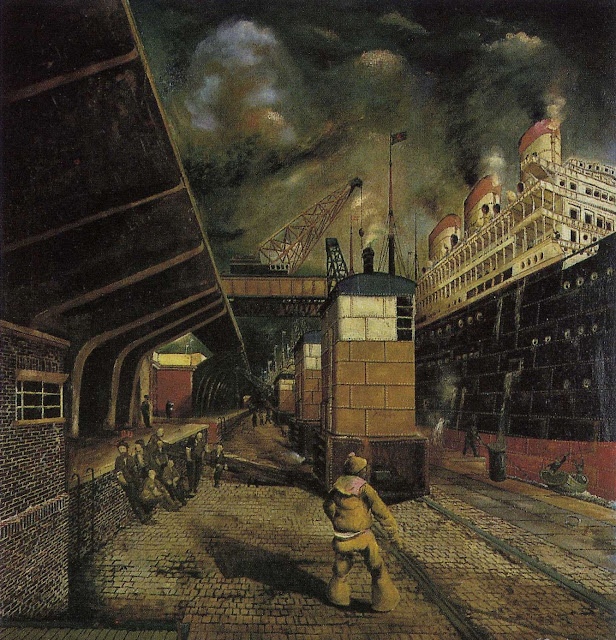
   I have looked into the art of the Weimar Republic and read about the accepted division within the Neue Sachtlichkeit between art called “verism” and “magic realism”. If one would add “surrealism” to it and “realism” it would make nearly all branches of the taxonomy of figurative art of XX century.{I know of “pop-art” and “photo-realism” but ignore it because “pop-art” was cynical art market manipulation, not art and “photo-realism” is moronic copying of snap-shots, not art either]
Verism has its origin in distant past when Roman portrait sculpture departed from idealized realism of Greek sculpture and insisted on great degree of individualization. Another words-it was art of the truth. In the 20’s in Germany the truth-telling was not directed at form but at content. Artists of that trend painted grotesque scenes of social decay with gleeful sarcasm. What unites them is involvement, engagement with social, political aspects of contemporary world. Some used ambiguity of jeering and delight in depicting the excess, debauchery, turmoil. Dix and Schlichter are outstanding examples of that movement. Others, like Katte Kollwitz expressed pathos of human miseries without endemic grotesque of the former.

                                                                     Albert Birkle

                                                                            Karl Hubbuch

                                                                     Rudolf Schlichter

                                                                          Georg Grosz

                                                                          Otto Dix

                                                                 Gert Heinrich Wollheim

“Magic realism” in all instances speaks with personal voice and invites into paintings of private sphere, far from blood and semen of verism. It is often a mythology of the quotidian, everyday rituals elevated to an added significance by good painting craft. There is something elusive in their art, something like gladness and gentle peace overlaying the content of their paintings, as if message above all was of savoring the simple gifts laid at the feet of each day.
                                             Balthasar KÅ‚ossowski de Rola known as Bathus

                                                                      Franz Radziwill

                                                                       Gregorio Sciltian

                                                                      Antonio Donghi

                                                           Francois Emile Barraud

                                                                        Georg Schrimpf

                                                                     George Tooker


Works of surrealism are different from magic realism by purposeful nonsensical incongruity of content. Instead of poetical sense-making [Remedios Varo,Paul Delveau,Claude Verlinde] it confronts the viewer with the absurd [Dali,Magritte,Ernst,]. It would be wrong to think that surrealism enlarged the world of imagination because imaginary visions have their own sovereign logic and consistency, while surrealism depends on breaking away from any kind of sense-making. Surrealism is no less hostile to the entire tradition of our culture build on sense than abstract art. Both of these artistic movements reject the central idea of communicating some sentient content through a piece of art. Yet, paradoxically they claim a pride of place in every museum housing the very tradition they are shredding.

But these neat divisions are hardly accommodating figurative art employing imagination of the last 90 years that is not fitting into the above historical movements. There is something called “fantastical realism”, there is “metaphysical art”,” visionary art” and even “fantasy art”. One can come upon “metaphorical art” as attempt at classifying realistic works  containing some poetical element. In cases I can think of it would just as well be called “magic realism’
                                                              Friedel Dethleffs-Edelmann

.And, neglected most, made by critics almost as quaint as oil-lamps is straight realism, deploying nothing fantastical, paradoxical, and surprising: just attentively, tenderly observed reality. Considering how utterly miraculous Reality really is it should suffice for the most shocking, revelatory content of them all.

Saturday, June 25, 2011

Fear of the Nude

If you are a figurative artist than I believe you know how difficult it is to exhibit nudes, even partial nudes in American settings. A country that has violence in high schools, mayhem on streets, several wars abroad and glamorizes heroes of violence in mass-media cannot face a nude in art center.
The shock, the trauma, even possible collapse and cardiac arrest may ensue if a visitor to public art show would be unexpectedly presented with a sight of a nude. Oh, horror! What those depraved Satans of art had done to my innocence, now and forever bespotted, contaminated with the offensive image!
 It was so cozy and safe when all the exhibiting spaces were covered with acreage of abstract art offending no one. You could walk safely past yellow circles and red rectangles and pajamas-like stripes toward some nasty splatter and listen to assertive screech of the art-docent showing how to say “wonderful” as if it was three words ,a name of a Dutch master Won der Fool. And so it is all “WONderful”, except that this exclamation is reserved for lady-docent and art curators because it is evaluative and you should pensively say “interesting…”while looking at the pajama-stripes art-work. 

                                                           Kenneth Noland

Here is art that shows gums but has no teeth. It is guaranteed to be safe for children up to the age of two. Past that age however it may actually slow the cognitive development from Homo erectus to Homo sapiens. Visiting today’s museum, library or art-center you are safely in Crayolaland build for children. In contemporary world people expect they can take their children any place with them and complain if some of those places are not accommodating ‘children’s needs’.
Here is an incomplete list of groups most likely to press against showing nudes at a show:
-women who think that painting nudes is comodifying woman’s body and therefore is “degrading” women.
-those among Christians who abhore pleasures, sensuality, Eros and beauty of human body.
-the rigid doctriners of modern art who see no place for figurative art in contemporary culture.
- parents who drag along, push strollers and piggy-back children everywhere and want the whole world to be expurgated for their little tots.
-small-cranium hypocrites who think that any, even the most reverent show of nakedness is “pornography”.

 Beneath is a tiny sampling of XX century nudes which I will increase over time.

                                              Balthasar Klossowski de Rola,known as Balthus

                                                                        Egon Schiele

                                                                              Otto Dix

                                                                   Stanley Spencer


                                                                       Andrew Wyeth