Monday, April 11, 2011

Part Two: Triumphs

            
Before a sculpture is a sculpture it is a protruding, thrusting forth lump of matter. Before something appears as architecture it is a building. The task of an architect is to superimpose on a skeleton of a building such highly organized aesthetics that the building will largely disappear: the “architecture” will replace the “building”. That disappearance happens to various degrees. Sometimes the sense of the “building” is so dominant it does not disappear at all and the pretense of belonging to architecture is based on the emphatic, mighty being-there rather than some realized superimposition of an architectural vision, the way so many water-towers are. But let’s turn attention to the opposite possibility, when the superimposition of architecture is so complete that the building is replaced in aesthetic experience for an awe-inspiring encounter like no other in palpable, three-dimensional world.                                                                                  
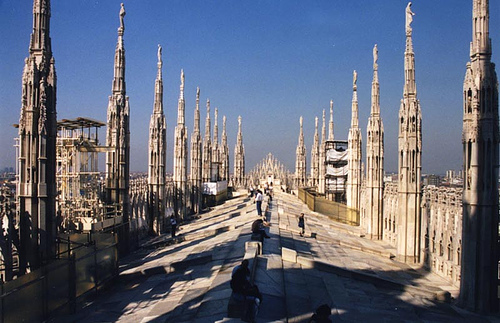
            Two examples here to show how far from practicalities and functionalism art of architecture at times had gone. First is Milan Cathedral, which was under construction for 600 years. It has 135 pinnacles and 2245 exterior marble statues. To call it marble forest would be wrong because all of those forms are in motion, though stationary - in “flamboyant” motion, spiraling flame-like upward. Confronted with such sight viewer’s habitual sense of reality vanishes and is displaced by a dream.
  

Second example of three-dimensional dream made of stone is also gothic flamboyant, from Rouen in France: St. Maclou cathedral. Just like Milan’s Duomo is exceeding what is “reasonable”, what would seem “enough”. Passion burns brightly there and the effect is well beyond any mule-train of expressive language. Perhaps it was constructed to serve as an irremovable question-mark for those who have it all figured out regarding true nature of God. Maclou might also, perhaps be viewed as a portrait of a cell with almost endless inner workings and complexities.


            Now, after getting a glimpse of what I would hope for in architecture let’s see if XX century can satisfy such expectation. I believe Antonio Gaudi was such architect. More than that-he was first and the sole true artist-architect since the Gothic. Oh, yes- there were many architects of   all those styles in between but they were building architecture the way that haberdasher or a “modiste” is fashioning a hat- with a sound crown and a bit sassy brim and some rhetorical elements of the décor. Not really art but rather like cake-decoration, funereal ceremonies or ikebana.
               Rather than recombining existing, commonly used parts in a new structure, Gaudi worked by inventing elements of architecture. His architecture contains more creativity than all of contemporary architecture of his time. While most of architecture we see has at best a slight effort toward distinctiveness, his buildings and all the parts are  seemingly endless outpour of creativity, inventiveness, new visions and new    structural solutions. As illustration of his creativity take a look at Gaudi’s columns:


         Usually his style is considered Art Nouveau but from a longer perspective of a century one can see how much larger and more powered by vitality his style is than the fainting sinuousness of Art Nouveau. In fact Gaudi stands looming like some Mediterranean Colossus: without antecedence or progeny. Like Hieronymus Bosch or William Blake he is sui generis. His inspiration has one source – nature. Stems of plants, chalices of flowers, undulations of sand ripples on a shore, surfaces and patterns of water. The very forces animating biomorphism are reflected, portrayed everywhere in his creations: forces of gathering tightly and languidly releasing, thrusting upward and holding fast, slow strength-gathering and spiraling upward.
Gaudi’s choice and treatment of materials should serve as a great lesson to artists of all visual disciplines. His famed wrought iron pieces are glorifying metal and its properties.


        His use of stone and its surfaces are amplified, made emphatically stony. The tactile quality of these surfaces are presented to us for sensual enjoyment as if invited to a tactile glyptothek or lapidarium.


The kind of world we enter in Gaudi’s creation is intriguingly strange and at the same time intimately familiar because he follows what is so deeply natural, already recognized by our nature, by kinship of all  living forms.
I know of no other architect who created more and left a world of visions larger, more original and more beautiful than Antonio Gaudi.I encourage you to perform a bit of an experiment on your mind and picture all of occidental architecture and remove Gaudi from that picture. What a gash,what bloody hole we just made- look! Without him we are left with those endless alleys of orthogonal geometries, luxurious prisons of perpendicularity – no place for the living.

Friday, April 1, 2011

Part One: Instead of Architecture

 From some distance of time one can look back at twentieth century architecture and with somewhat rough division separate two major trends. Both were bringing innovation but their styles were as antithetic as if occupying opposite corners of what is possible within three dimensions.
Modern formal austerity proposed buildings inspired by simple geometry and had its origin in Bauhaus designs. What they accomplished was bringing gulag closer to the European industrial workers by building dwellings stripped of any softening, warm or natural elements.
Look at the hopelessness staring from the rows of these penitentiary windows behind bars: they were copied and copied again all across the world!
            
 Their immense success was not with workers, which did not want to live there but with other architects who developed the Bauhaus style into International style .Perhaps the essence of it is best encapsulated by the famous motto of Mies van der Rohe “less is more”. And so, it was less, much less.
This is Ludwig Mies van der Rohe’s  practical design of place of mass execution by firing squad that can also serve temporarily as storage for inflatable people.

Less is more! The wisdom of this saying is as good as “less truth is more truth” or “less freedom is more freedom”. However  transparent is idiocy of this maxim it  was not obvious to people with great deal of money and the world got those oversized refrigerators masquerading as architecture.


In all fairness I should add that Germans were not the sole perpetrators of those architectural crimes.Take a look at the achievements of the venerated Le Corbusier:
How nice it must be to wake up in this tackle box and feel like a disposable cipher.
And another of his gifts to humanity:

An architect in the reverent comment under this picture called it “elegant”. Indeed, indeed.
Notice the outer shell made of massive ferro-concrete protecting against atomic attack from the local villagers.
There is no need to add any more examples of Modern Movement. We live surrounded by them. Even that they look so obtuse, they speak. Their message is loud, impersonal jeer emanating from the corporate maw.
In the Second Part I will look at another trend in XX century architecture and it will be far less depressing.


Tuesday, March 22, 2011

Change without Progress

                 Most art historians think of art history as evolutionary process of evolving styles which by some historical necessity die out and are replaced by next, more advanced styles in a long creative march. Obviously this model mimics other disciplines of human endeavors and indeed not just human but of all life. We start with very primitive forms and progress toward great complexity and sophistication. This view, used as an explanatory model has great power by offering to the mind hungry for easy, understandable, all-encompassing explanation an answer of simplicity. Theory of Evolution has such explanatory power. When applied to art history it proposes succession of styles orderly following a necessary path. In this view History marches onward not just along a linear path but upward as progress.
If that is so than whatever follows yesterday should by necessity of history be better, improved over the past-but is it? One cannot deny the facts of periodicity in art styles; they do have their own beginnings, development into its own high-style and a kind of “baroque” or an equivalent of “gothique flamboyant” of a late faze of its development. That much is very true. However, those inner developments are changes not progress.
              In the history of nineteen century art Impressionism is always presented as progress over academic, stale, overburdened with artifice realism of the late XIX century. Much of what was exhibited and lauded at yearly salons of the time was indeed too sentimental, serving expectations of the middle-classes too well. Artists provided them with competently executed comforting banalities. Impressionism brought in a fresher palette of dapple light, de-materialized somewhat the objects in view so that they seemed spun of light rather than solidities. However the subject matter has not been augmented deepened or made more interesting. On the contrary; it brought picture of the world singularly boring, banal, repetitive and un-imaginative, un-engaged with the world. It surely was not a progress but a mere change and considering how much less skill, less craftsmanship and thought is needed to complete an impressionistic painting –in fact seeming more like a regress. But when one looks closer, in a less schematic, less linear way at that era it is important to recognize that the true significance of Impressionism has been bolstered, inflated beyond its deserves by the enthusiasts of the progress view of art history. Contemporaneously with Impressionists a long row of artists who rejected dapple light&purple shadows created superb art and their achievement will grow in public esteem ever higher, while the masters of orange light and purple shadows will fade as their paintings alarmingly have had.


Monday, March 14, 2011

Art of Growing Toenails

            Once I was approached by a well-intending guy in the basement of a Presbyterian church where everybody gathered after a decent performance of the excerpts from the Messiah and he said “ I hear you are also growing antique roses-that’s an art too,I’m sure” . Perhaps because I was angry having to drink non-alcoholic punchless punch with tiny marshmallows floating atop I told him,no,growing roses or raising guinea-pigs is not an art,it is a skill,like shoe-shining .We have among our activities skills, crafts and indeed art, the last one being very rare nowadays.
           How hastily and undeservedly just about anything gets to be Art! Pierced nostrils, nipples, tattoo is Body Art. Some tossed julienne-cut medley of vegetables is now Culinary Art. Significantly just when there is so scantily little real art among the contemporary arts productions, pretty much everything gets the distinction of art, Hardly any mediocre potter is considered a craftsman because his level of competence does not warrant that once proud name, but be sure he thinks of himself as an artist and exhibits in art-shows.
          There was once a different edition of the mental world .In it only art was art, while crafts had to shine with masterful workmanship, where one had to exhibit mastery in execution or else would be dismissed and considered a failure or a con-artist.
That world has been, piece by piece almost totally dismantled.

Thursday, March 10, 2011

Subtle difference found! Hooray,Hooray!

In the New York Times from March there is a short, mercifully short article that reports the astonishing results and even more baffling conclusions regarding abstract art. Here it is:

Abstract Art Isn’t So Inscrutable, Study Finds

By MELENA RYZIK
Do the canvases of Cy Twombly look like finger-painting to you? No matter how you answer, you’re probably more an of aesthete than you think.
Building on a put-down commonly directed at abstract art – “my kid (or a monkey/elephant) could do that” – researchers at Boston College tested whether laypeople and art students could distinguish between abstract paintings by professional artists and those made by schoolchildren and animals. As they report in the journal Psychological Science, even non-experts could tell the difference between finger (or trunk) painting and the real deal.
“Participants preferred professional paintings and judged them as better than the nonprofessional paintings even when the labels were reversed,” the study’s authors, Angelina Hawley-Dolan and Ellen Winner, write.
In the study, which was discussed in a story on the Miller-McCune Web site, Ms. Hawley Dolan, a Ph.D. candidate in psychology and Ms. Winner, a psychology professor, asked 72 undergraduates – studio art and psychology majors – to look at slide shows of similar-looking pairs of paintings. Each pair included a work from an art history textbook and one made by a child or a monkey, gorilla, chimpanzee or elephant. Sometimes they were labeled (“artist,” “child”), sometimes they weren’t, and sometimes the labels were incorrect.
“Art students preferred professional works more often than did non-art students, but the two groups’ judgments did not differ,” the researchers write, concluding: “The world of abstract art is more accessible than people realize.”

So, they found that this group of students in the main considered works of the great luminaries of abstract smears more preferable than ones done by monkeys and elephants. Among the comments there was an abstract painter who complained that he felt humiliated by the study [and there is always someone nowadays whose feelings were hurt-poor injured in his tender pride baby] because comparison like this would not be done in any other serious profession. That much is certainly true, but is it not telling that it seems reasonable to see why indeed the works of abstract art and primates were compared? Among the rich theatricality of his “feelings” I suggest he chose another emotional reaction. How would shame do? Sense of fraudulent behavior perhaps?
And now let’s take a look at the powerhouse of intellectual muddle-headedness of the conclusion: “abstract art is more accessible than people realize”. How that conclusion jumped out of nowhere? All we know now, after this epochal study is that a bunch of art students realized that the contrived chaos by the abstract artists can often be distinguished from the real thing done by monkeys. Secondly-it makes abstract art no more accessible whatsoever-if anybody actually wanted to access it, taking that to mean comprehend it. We know what monkeys mean by making smears; should we suddenly assume there was a different meaning when we are told that some of those things were done by grown homo sapiens?
High up the emerald canopy of Amazonian forest fruit-eating monkeys defecate very frequently making moving below full of constant surprises. If the “researchers” would place some abstract artists, conceptual “cutting-edge” pioneers of the new-york-quality new up there, would the dedicated students below be able to give equally “significant” conclusions, given the same fruity diet above?

Friday, March 4, 2011

No ideograms past toddler age!

                   Here is an important argument against modern art When a child develops he is almost always drawing, providing visible proof to his relieved parents that their offspring is normal. At that time his drawings are series of ideograms: the head is a watermelon oval, eyes are two dots and nose is a vertical line. Wavy lines would stand for water and upturn curve for a smile. How wonderful ! Now our child joined in his development aborigines of lowest intelligence. Had he stayed at that stage we would certainly worry. But the next and very significant moment in the child’s development comes by and the kid realizes that the nose does not look anything like a black line nor eyes like two dots. Observation told him so and children at that point stop drawing because it looks no more like easy playing but hard work.
Now,dear enthusiasts of Picasso, Mattise,Braque , Klee or Dubuffet- in what human endeavor would you recommend returning to child’s competence level? Would you praise the poet who writes like four-years old, a musical compositions drawing on sounds of hop-scotch rhymings? A sculptor who mimics play-dough creations in pre-school?
What spiritual deformity could allow an artist to reject the entire glory of the observable world for infantile ideograms of dots and straight lines? Look at the faces you love and think that the only available record of your adoration of them would be portraits by Dubuffet or Bacon. Modern artists looked at Reality and shook their heads with dismissal--not good enough for admiration, awe, praise, close and loving study, for tribute to its glory. Not good enough for their demanding standards!

Jean Dubuffet,considered {by people like him] to be one of the greatest French painters of the XX century. Bravo,bravo.
Francis Bacon.Another triumph.
And for all those faithful admirers of Paul Klee’s genius, one of his splendid masterpieces


:

Thursday, February 24, 2011

Little Pin of Low Mimetics

                  Borrowing from an excellent source for clear-thinking, Northrop Frye, one can find a useful division in literary art into “high” and “low mimetics”. Let us apply this division to representational painting.
High mimetics would fit paintings where objects and situations presented were idealized, as if air-brushed of all extraneous accidental imperfections .They are presented to the viewers at their very best of possible appearances. That usually is true throughout the image: it seems to convey an ideal state of the shown world. Leonardo and Raphael painted in the High Mimetics.
Seems to me that the taste for Low Mimetics arose in the Northern painting first and mostly remained there. Surely there would be some exceptions to be found elsewhere but the true seat, true hub of Low Mimetics is in the North.
In the “Deposition” by Rogier van der Weyden notice that the figure of Saint Anne is wearing a white scarf held in place by a pin. The entire painting is filled with crying mourners and still Weyden felt an obligation to install the little pin as if to show that reality is demanding this detail of practicality, no matter how drenched with tragedy is the subject. It strikes me as the spirit of Low Mimetics.

Can you imagine such attachment to the truth of daily life in Leonardo or Raphael? Italian art had to wait for almost one hundred years to see realistic, mundane elements in their art, brought by Caravaggio.

However bountiful and lush is this display he also included holes eaten out by insects and a wormy apple, because the passion for the real was so much stronger than the outside expectations of the ideal of high mimetics. Another example of low mimetics is in those true to life dirty feet of a pilgrim below, also by Caravaggio::

 Returning to the Northern art of the era [around 1600] we find low mimetics thriving to unprecedented degree. It prompted  a book by a painter Gerard de Laresse warning  painters against the abominable habits of depicting ,with obvious glee interior scenes of brothel trade, lecherous drunks cavorting in country pubs, lewd scenes with an overwhelming air of approval, paintings containing men relieving themselves in some shaded part of an interior, fondling eager hussies, gambling, fisty-cuffs and worse. Commentaries written now analyzing the meaning of those Dutch paintings are searching everywhere to support  rather pious idea that these works were honestly meant to be in fact stern warnings against debauchery, fornication, gambling, drunkenness and gluttony and other sins so lovingly depicted, I forgot to include.

Adriaen van Ostade: how is that for low mimetics?

And here is Rembrandt’s etching with his splendid chiaroscuro.
Thinking about mimetic arts: painting, sculpture, poetry, plays and prose I see that across ages the proportions of high and low mimetic are always adjusted not by tenor of the times but rather by individual taste of the artist. What sort of the world he wants to show to us- how close to reality he actually knows he will create his reportage on the world? Or, almost frightened by that possibility would he rather present us with another, alternative world, much improved wish or day-dream of elevated perfection would he unveil?

Monday, February 21, 2011

Puzzling Disparity

            There is something significant that should be examined and well understood in comparing the billowy success of modern visual art and collapse and disappearance of “experimental poetry”, ”experimental novel” and “experimental music”. They all vanished. Where is that inspired genius who was publishing poems consisting of one word repeated hundred times, where is the energetic composer, who was breaking concert pianos on stage? Who is reading Robbe-Grillet? Who is demanding that brilliant piece of new music by John Cage consisting of four minutes and thirty three seconds of silence?
            Oh, you fickle public –one day you sit in rapped attention when Cage is performing his difficult composition  and during the intermission hear that” he makes us aware of the primal silence”[ or some rubbish like that] and never played his music again?
            Somehow in music concert halls no one is breaking pianos any more, listens to silences, no one is publishing one word poems and nobody is writing experimental novels about nothing at all, like the celebrated Robbe-Grillet. Contemporary novelists are writing excellent prose devoid of any idiotic “experimentations”, poems are moving our hearts as before,while any classical music composed after “Metamorphosen” by Richard Strauss in 1945 is very rarely performed.
           And yet- on my territory of visual arts, coverall clad workers carefully, very carefully are moving into position a large chunk of rock painted blue to be the marvel and the pride of the Tate Gallery. Other words- cretinism thrives in visual arts while literature and music was allowed to give it well deserved shove of the cliff. I am puzzled by that disparity.
          Perhaps the explanation goes like this: when you buy a book you page through it and when it seems promising, engaging, illuminating, or sparkling with clever language you get it. Similarly with classical music- when it is a collection of discordant, chaotic screeches and painful yammering you toss it back. Wrapping buildings, cutting and displaying cows in formaldehyde –that is all sponsored by the limitless generosity of multinational corporations. Cunningly and with glee they see it as a welcomed absurdity helping to spread the sense of resignation, alienation from truth, beauty, our culture, even common sense.

Friday, February 18, 2011

"Story-Telling"

I am about to contribute three paintings to a show entitled “Story-tellers” and the organizers requested from each participant a couple of paragraphs containing thoughts on story-telling. My opinions are here:
There seems to be two sources for content in an artwork; extraneous ones, like a literary source or an interior “story” that fulfils itself within the confines of the art-work without pointing outward for its origin or its elucidation.
Before art became truly itself there was decorated craft and by augmenting decoration with story-telling it has become art. That happy mélange lasted to great success until Impressionism. There is still some vestigial content in Impressionism but it is purposefully chosen to be minimal, un-assuming and banal for the sake of underscoring the decorative values of the paintings

                          
               Fragment of Paul Cezanne’s painting ;already cleared of the "story-telling"abomination.Even though there is no "story" there is a message there.Painter seems to be telling the viewer:I looked from the window of my brother's house at these trees but the truth of their morphology meant little to me.I used their general direction and flat siluettes  to serve as heavy-handed props in my composition the way the Lords use their servants while avoiding to look at them.

Fragment of a Gerrit Dou painting [for a larger view click the link]        


 From the triumphal reign of Impressionism the entire officialdom of art frowned at content viewed as anachronism burdening art with non-artistic content. The painting was supposed to be about painting, not about something else. The only content ever accepted afterwards was the kind of content that was a joke about content. Of course truly serious, great artists were not asking art critics for permission to paint coherent, thoughtful, humanistic content. While museums were being filled to the rafters with hasty products of Albers, Rothko, Rauschenberg, Lichtenstein and Klein -the real great artists worked ignored by the foam-machines of fame and praise. Their sin was the “story-telling”.
There is obviously something intentionally belittling in calling poetical, descriptive content of passionate inquiries into visible world “story-telling”, as if they were woven by infantile minds to put children to sleep. I wonder how enthusiastic would modernists be if we called for participation in a show of they work “Optical Trash”

Sunday, February 13, 2011

Intensity of gaze

From the “Art of the Arts” by Anita Albus:
“Painting was able to claim its place as the art of the arts as long as it still encompassed the seven liberal arts within it; as long as the painters, in the contest of the arts, gave their utmost to breathe life into the world. Without their learning, without their counterbalance of morality, a new peacock butterfly can never spread forth its wings from the subverted profession. Look back at painting’s multilayered lepidopterous phase. The Lunar Orbiter sent back its images of our blue star from the immeasurable, lifeless reaches of space. If we had fully grasped this star’s uniqueness, we would look with different eyes at the fly that has finished its morning wash and is strolling over apple-green waxy skin around a globe with a stalk. Perhaps then we might have regained the intensity of gaze that distinguished a Van Eyck,or Rogier van der Weyden,Patinir or Gerard David, Flegel or Goedaert. We should take up from them – not to do the same as they did, but to have a share in the same: in perfect creation, in the imitation according to creation that is the form of our immortality.”
Fragment of “Madonna of Chancellor Rolin” by Jan van Eyck. Somewhere in this painting, at shoals in the distance teenage boys are skipping stones. I only read about it , never came close enough for such close examination, but to know it helps me, as a painter ,as a supplicant in the temple of my profession  to bear the grievous indignities of contemporary art to know they are there, skipping stones and that they will do it endlessly to hold the mental cosmos of our culture intact.