Sunday, May 8, 2011

European Figurative Sculpture XX century

There is so much excellence in figurative sculpture of XX century in Europe I am at great pain having to limit all that splendid art-work to a sampling due to constrains of a little blog. From the rocks of Gibraltar to the Ural Mountains figurative sculptors were still chipping away marbles and making plaster molds for bronzes as if fourth century B.C. in Attica was just yesterday.


Enric Casanovas


Gerhard Henning


Kurt Schmid-Ehmen

Anton Hanak                                   


                                                                 Charles Despiau


Marnix D'Haveloose

Aristide Maillol.

Arno Brecker

Paul Lewandowski


Alfred Auguste Janniot


Paul-Francois Niclausse


Francis Derwent Wood

Alfred Gilbert


Thomas Brock


Pier Pander


Adolph von Hildebrand

Imre Csikasz


Vanja Radaus


William Reid Dick


Stephan Sinding


The selection above shows sculptors who were adhering very closely to the observation of the models with strong conviction that strict realism makes truth beautiful.
Now let us look at art of those sculptors with visions propelling them away from strict realism and imbuing their sculptures with expressiveness uniquely their own.


Antoine Bourdelle


Ernst Barlach


George Minne


Francesco Messina


Venanzio Crocetti


Jan van Luyn
                                                                        
Libero Andreotti

Leon Ernest Drivier


Stanisław Szukalski


Quirino Ruggieri


                                                                        Katte Kollwitz


                                                                      Gustav Vigeland

                                                                    Renee Letourneur


                                                      Giacomo Manzu 

Quite different culture is represented here than the one that proclaims Alexander Calder’s play-pen doo-dads to be great art, would you agree?             

Tuesday, May 3, 2011

Figurative Sculpture of XX century

The world of XX century sculpture has two separate histories: the accepted and promoted one of Modern art and figurative continuation of Western tradition. Even the greatest of their masters are not to be found in art history books surveying XX century art. They were guilty of grievous transgressions, they looked at and studied human form and found beauty there, they searched  for meaning and made sculptures imbued with allegories and metaphors. Those artists continued Egyptian, Greek and Roman tradition of realistic sculpture that is capable of evoking feelings in viewers. Regrettably- it was all condemning them to banishment by the severe judgment of new dictators of artistic values.
Let us take a small sampling of the XX century figurative sculpture and make an independent judgment over their artistic merits. What you will find admittedly lacks primitivism, silliness, shock or stupefaction so greatly lauded by the dictators of Modern art but do suspend your disappointment for these shortcomings. Allow to assume a set of long forgotten aesthetic expectations of art evoking physical beauty, of refinement, of nobility, of subtlety or charm, of inner strength or tenderness. Indeed, a vast array of emotions has been emphatically expressed in those sculptures from care-free joy and passionate abandon to gravity and sepulchral grief and loss. The world of human emotions is elevated, ennobilized and rhapsodized to tell us that our civilization, our aspirations, ideals and our deeds as reflected in those marbles and bronzes are triumphs of human spirit reaching for ascension.
Cecil Howard

Daniel Chester French

                                                                   Daniel Chester French
                                                              Alexander Stirling Calder
                                                             Alexander Stirling Calder
                                                                       Albin Polasek

                                                                       Albin Polasek
                                                                        Albin  Polasek

                                                                       Chester Beach

                                                                           Lorado Taft

                                                                         Lorado Taft

                                                                          Lorado Taft

                                                                       Harriet Frishmuth

The above sampling is of American sculptors. A sampling of European figurative sculpture will follow. Soon.


Tuesday, April 26, 2011

Sculpting Without a Brain

At the beginning of XX century western sculpture divided itself, but not like a happy amoeba into two healthy offsprings wagging their flagella. It divided into figurative sculpture which continued what Della Robbia or Donatello meant by “sculpture” and
Modern sculpture, a kind of tyranny of idiocy, which quickly became the only allowable kind of sculpture to be promoted by the mind-guardians of officially approved values.
From the outside, from Mars looking with fresh eyes at any example of modern sculpture there is absolutely no chance that by gathering all our inner resources and confronting such sight we could react to it by declaring truthfully that it is beautiful, moving us  or that it is enriching, augmenting our lives. It is quite audaciously a piece of junk elevated on a pedestal to bask in unearned glory.

The sculptor-di Suvero.

Recent quality control commission of the Food and Drug Administration conducted an astute study of alphabet soup content .The head of the commission, prof. Ursino Crepusculatti showed the astonishing array of rejects they found there. “Truncated, malformed and not conforming to any known alphabet!” was his conclusion. Here are some choice examples:
The onion rings’ author Tom Sayre
The arctic excreta are by John Searles, while the blushing red beautie is by Alex diAmbrosio.


Now that I refreshed your memory of modern sculpture I want to turn toward some general remarks regarding Form, because in the field of sculpture form is as pronounced as color is upon encounter with painting. In confronting a sculpture the presence of form is the first awareness and whatever follows the form is disclosing it, giving it. So, the sculptor is a Form-Poet. I believe a dancer would most readily understand that, because a dancer carries her dance at all times. She has her forms in motion fully incorporated and throughout her whole body. Sculptor feels his forms across his tensed body: they are not simply stored like tubs of Crisco but teeming with potential, pent-up kinetics and in the process of sculpting he gives each form its energetic qualities.
There is no form to be found that is equal to beauty of natural form. This truth has been challenged by artist of Modern art and the proof of their colossal failure is evident even to children. What Modern sculpture found is a repository of hostile geometries, orthogonal steel-traps, sometimes called “metallic turds”{Tom Wolfe}which are not addressed to us but to insects that seem not  to mind inhuman aesthetics.
Second Part will show a selection of figurative sculpture of the XX century that will enchant you and perhaps will make you angry knowing that every museum in the country and elsewhere is clogged with sculptures like this


No mistake here-it is a “new” acquisition for the Hirschhorn Museum entitled “For Gordon Bunshaft” by Dan Graham. Yes, it is not an ugly vent for prison below, but a “sculpture” selected I am sure after long weeks of careful deliberations and discussions to assure the public would get access to the pinnacles of our artistic achievements, because they say “proud nation deserves great art”.
By the way- some of the titles of the sculptures might be inaccurate and the FDA report ,as they often do , imagined too.

Sunday, April 17, 2011

Elusive Authorship

A sculptor is designing a sculpture but does not sculpt it. He sends it to be executed by competent stone carver or a metal worker. Is he the author of the resulting art-work? I assume most of you would say-certainly, he is. I’d say- he is not.
Let’s say I have a splendid vision for a painting, but being a busy man I hand the elaborate task to my assistant and once the work is done to my satisfaction I sign it and exhibit it as mine. Fraud? Or perhaps it’s just efficient use of my resources. This time I guess much fewer of you would think that a painting could be painted by someone else and still retain the authorship of the artist.
That means the authorship is graduated from total [idea and execution] to very limited [idea only]. But what is the degree of authorship when even the idea is not really of the artist’s creation? Let’s say I decide to photograph a Monarch butterfly and I lurk in the garden until I get a good photo. There is hardly any originality in the “idea”; they are photographed all the time by many millions. The object of my choice is not a chimera of my imaginings. The way it was “captured” had simply documented it with the typical optics of a camera .The execution of the image belongs to some Oriental demi-god Nay-kon or Ca-Ca Non and all I did is  pushing  the button like a hotel guest pushing the elevator button. Should I step out of the elevator and say to everybody in the lobby that I am the Author of this unique elevator-ride? The only case I know when pushing buttons results in full authorship is typing a new book. Taking snapshots of the world is preserving data not belonging to you or anybody else you know. The author is mysteriously hidden, or- the author is the only thing you will ever see. To claim the authorship of a photo seemed always to me monstrously presumptuous in view of the plain fact that gathering data does not make you anything more than a collector.

In choosing painting as the discipline among visual arts gives one vast territory and opportunities for authorship. Whereas in other media much is already in place, like language for a novelist or granite for a sculptor, a painter can invent nearly any kind of rules expressed in the window of his work. Shadows in his painting can be so ancient they rust and peel. Every verticality can be melting as it rises. Every color can be shown not in its glorious fullness but as becoming itself, tending gradually toward its realization. The degrees to which objects are alive can be greatly amplified. I have to stop myself here sensing that I made my point: the authorship in painting can be huge, touching nearly every molecule in the painting. What exhilarating opportunity! How can we ever go to sleep!!!?

There is a deeper layer to the subject: are we ever true authors, even if the vision is ours and the full execution is done by our hands? My experience gives me an option to employ sharp power of rational thinking and arrive at some idea for a painting that by feeding, jazzing-up and many interventions can become a clever contrivance. Another option is to send a wish for a vision and wait for its arrival. It is all very unpredictable, wholly irrational, impossible to force or direct in any way. It may come or it may torment you with tardiness but when it suddenly shows up in your mind it is very surprising and new. A gift, really.Where from? Now, to approach an answer to that question I want to be unusually cautious. In the first place I would say-nobody knows. Sure, there are dust-bins of the old “sub-consciousness” mythology but that is just re-naming “nobody-knows”

Monday, April 11, 2011

Part Two: Triumphs

            
Before a sculpture is a sculpture it is a protruding, thrusting forth lump of matter. Before something appears as architecture it is a building. The task of an architect is to superimpose on a skeleton of a building such highly organized aesthetics that the building will largely disappear: the “architecture” will replace the “building”. That disappearance happens to various degrees. Sometimes the sense of the “building” is so dominant it does not disappear at all and the pretense of belonging to architecture is based on the emphatic, mighty being-there rather than some realized superimposition of an architectural vision, the way so many water-towers are. But let’s turn attention to the opposite possibility, when the superimposition of architecture is so complete that the building is replaced in aesthetic experience for an awe-inspiring encounter like no other in palpable, three-dimensional world.                                                                                  
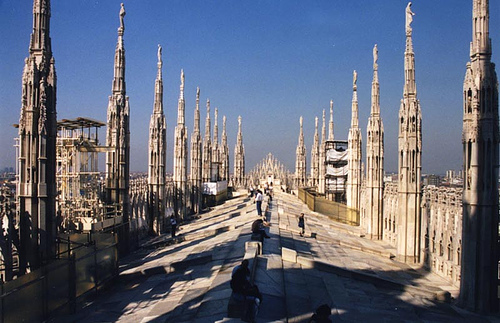
            Two examples here to show how far from practicalities and functionalism art of architecture at times had gone. First is Milan Cathedral, which was under construction for 600 years. It has 135 pinnacles and 2245 exterior marble statues. To call it marble forest would be wrong because all of those forms are in motion, though stationary - in “flamboyant” motion, spiraling flame-like upward. Confronted with such sight viewer’s habitual sense of reality vanishes and is displaced by a dream.
  

Second example of three-dimensional dream made of stone is also gothic flamboyant, from Rouen in France: St. Maclou cathedral. Just like Milan’s Duomo is exceeding what is “reasonable”, what would seem “enough”. Passion burns brightly there and the effect is well beyond any mule-train of expressive language. Perhaps it was constructed to serve as an irremovable question-mark for those who have it all figured out regarding true nature of God. Maclou might also, perhaps be viewed as a portrait of a cell with almost endless inner workings and complexities.


            Now, after getting a glimpse of what I would hope for in architecture let’s see if XX century can satisfy such expectation. I believe Antonio Gaudi was such architect. More than that-he was first and the sole true artist-architect since the Gothic. Oh, yes- there were many architects of   all those styles in between but they were building architecture the way that haberdasher or a “modiste” is fashioning a hat- with a sound crown and a bit sassy brim and some rhetorical elements of the décor. Not really art but rather like cake-decoration, funereal ceremonies or ikebana.
               Rather than recombining existing, commonly used parts in a new structure, Gaudi worked by inventing elements of architecture. His architecture contains more creativity than all of contemporary architecture of his time. While most of architecture we see has at best a slight effort toward distinctiveness, his buildings and all the parts are  seemingly endless outpour of creativity, inventiveness, new visions and new    structural solutions. As illustration of his creativity take a look at Gaudi’s columns:


         Usually his style is considered Art Nouveau but from a longer perspective of a century one can see how much larger and more powered by vitality his style is than the fainting sinuousness of Art Nouveau. In fact Gaudi stands looming like some Mediterranean Colossus: without antecedence or progeny. Like Hieronymus Bosch or William Blake he is sui generis. His inspiration has one source – nature. Stems of plants, chalices of flowers, undulations of sand ripples on a shore, surfaces and patterns of water. The very forces animating biomorphism are reflected, portrayed everywhere in his creations: forces of gathering tightly and languidly releasing, thrusting upward and holding fast, slow strength-gathering and spiraling upward.
Gaudi’s choice and treatment of materials should serve as a great lesson to artists of all visual disciplines. His famed wrought iron pieces are glorifying metal and its properties.


        His use of stone and its surfaces are amplified, made emphatically stony. The tactile quality of these surfaces are presented to us for sensual enjoyment as if invited to a tactile glyptothek or lapidarium.


The kind of world we enter in Gaudi’s creation is intriguingly strange and at the same time intimately familiar because he follows what is so deeply natural, already recognized by our nature, by kinship of all  living forms.
I know of no other architect who created more and left a world of visions larger, more original and more beautiful than Antonio Gaudi.I encourage you to perform a bit of an experiment on your mind and picture all of occidental architecture and remove Gaudi from that picture. What a gash,what bloody hole we just made- look! Without him we are left with those endless alleys of orthogonal geometries, luxurious prisons of perpendicularity – no place for the living.